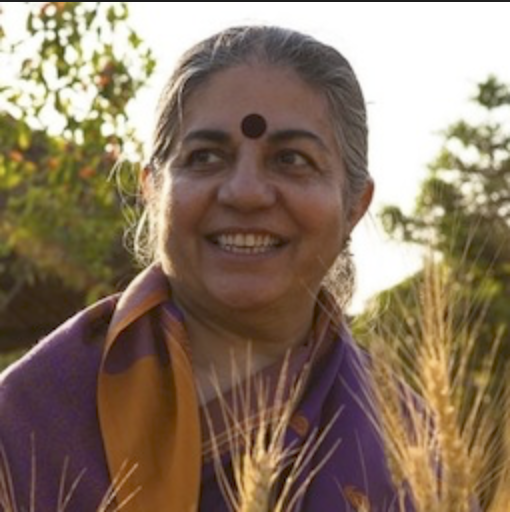
Vandana Shiva is an Indian physicist and social activist. Shiva founded the Research Foundation for Science, Technology, and Natural Resource Policy (RFSTN), an organization devoted to developing sustainable methods of agriculture, in 1982.
Shiva worked to prevent clear-cut logging and the construction of large dams. She was perhaps best known, however, as a critic of Asia’s Green Revolution, an international effort that began in the 1960s to increase food production in less-developed countries through higher-yielding seed stocks and the increased use of pesticides and fertilisers. The Green Revolution, she maintained, had led to pollution, a loss of indigenous seed diversity and traditional agricultural knowledge, and the troubling dependence of poor farmers on costly chemicals. In response, RFSTE scientists established seed banks throughout India to preserve the country’s agricultural heritage while training farmers in sustainable agricultural practices.
In 1991 Shiva launched Navdanya, meaning “Nine Seeds,” or “New Gift” in Hindi. The project, part of RFSTE, strove to combat the growing tendency toward monoculture promoted by large corporations. Navdanya formed over 40 seed banks in India and attempted to educate farmers on the benefits of conserving their unique strains of seed crops. Shiva argued that, particularly in a time of climate change, the homogenization of crop production was dangerous. Unlike native seed strains, developed over long periods of time and therefore adapted to the conditions of a given area, the seed strains promoted by large corporations required the application of large amounts of fertilizer and pesticides.
In addition, many such seed strains were genetically engineered and patented, preventing farmers from saving seeds from their harvests to plant the following season and instead forcing them to purchase new seed each year. Shiva’s idea was that a decentralized approach to agriculture, based upon a diverse array of locally adapted seeds, would be more likely to weather the vagaries of a changing climate than a system relying on only a few varieties. She anticipated the danger of the WTO’s which allowed for the patenting of life forms and would therefore make it possible for corporations to essentially require farmers to continue to purchase their seeds after local varieties had been eliminated. She spoke out against the agreement at the 1999 WTO protests in Seattle. Shiva had launched Diverse Women for Diversity, an international version of Navdanya, the previous year. In 2001 she opened Bija Vidyapeeth, a school and organic farm offering month-long courses in sustainable living and agriculture, near Dehra Dun.
 Science in India